Marketing takes a lot of small decisions. Who is this for, what should the ad say, when should the email go out, and what happens after launch day?
This guide gives you ChatGPT prompts for marketing that help with each of those steps. You will get prompts to understand your customer, write copy, plan a launch, and avoid the mistakes that hurt trust, like unproven claims and fake reviews.
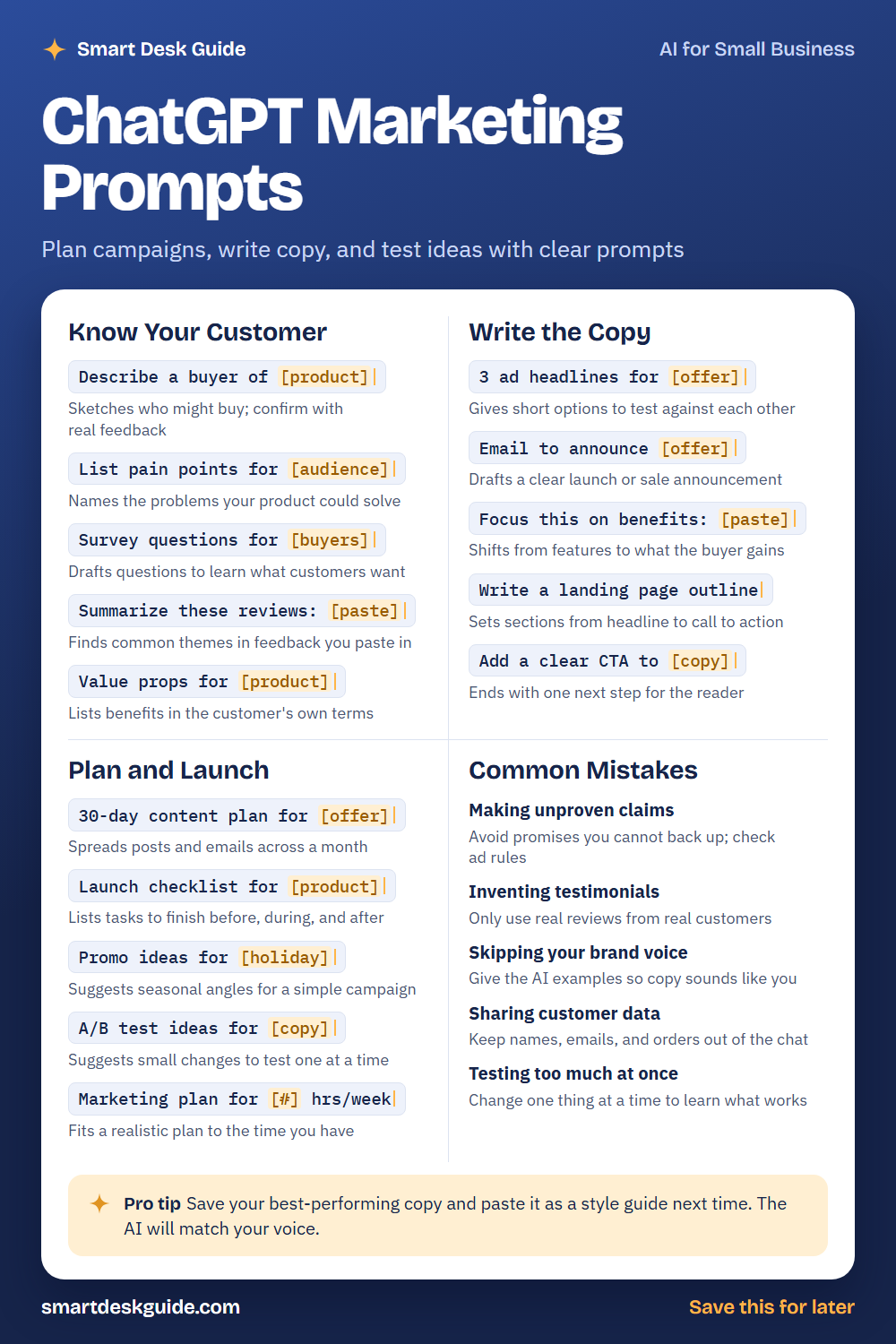
Use the cheat sheet below as a quick reference. Then read on to see when to use each prompt and how it looks filled in.
How to Use These Prompts
Words in [brackets] are blanks. Replace each one with your own details before you send the prompt.
Before: 3 ad headlines for [offer]
After: 3 ad headlines for a free first-week trial at a neighborhood yoga studio.
The more you say about your product, customer, and goal, the better the copy. These prompts work the same way in ChatGPT, Claude, and Gemini. Treat every result as a draft, and review each claim before it goes public.
Know Your Customer
Describe a buyer of [product]
A clear picture of your buyer makes every message easier to write. The AI can sketch a likely customer, but it is guessing. Confirm the sketch with real feedback from people who buy from you.
Example: Describe a buyer of handmade soy candles sold at local craft fairs.
List pain points for [audience]
Pain points are the problems your product could help solve. This prompt gives you a starting list. Cross out anything that does not match what customers tell you.
Example: List pain points for new small business owners who are trying to manage their own bookkeeping.
Survey questions for [buyers]
Short surveys show what customers actually want. Ask the AI for a few clear, neutral questions. Avoid questions that lead people to a particular answer.
Example: Survey questions for customers of a neighborhood bakery, with 6 short questions about flavors, prices, and pickup times.
Summarize these reviews: [paste]
Reviews hold useful patterns. Paste real feedback and ask for common themes. Remove customer names and personal details before you paste.
Example: Summarize these reviews into common themes: Great flavor but slow pickup. Loved the birthday cake. Line was long on Saturday.
Value props for [product]
A value proposition explains why someone should choose you. Ask the AI to list benefits from the customer’s point of view. Keep only the ones that are true.
Example: Value props for a mobile dog grooming service that comes to the customer's home.
Write the Copy
3 ad headlines for [offer]
Short options are easy to compare. Ask for headlines with different angles, like saving time, saving money, or trying something new. Check ad platform rules before you publish.
Example: 3 ad headlines for a free first-week trial at a neighborhood yoga studio, each under 40 characters.
Email to announce [offer]
A launch email should be short and clear. Include the offer, the date, and one next step. Ask the AI to keep the tone friendly, then edit to match your brand.
Example: Email to announce a spring sale at a small garden shop. Keep it under 120 words with one clear button.
Focus this on benefits: [paste]
Features tell what a product is, and benefits tell what it does for the buyer. This prompt shifts the wording toward the buyer. Check that each benefit is accurate.
Example: Focus this on benefits: Our planner has 12 monthly pages, a ribbon, and a hard cover.
Write a landing page outline
A landing page needs a clear order: headline, benefits, proof, and a call to action. This prompt gives you the structure. Fill in each part with your real details.
Example: Write a landing page outline for a weekend photography workshop for beginners.
Add a clear CTA to [copy]
A call to action tells readers what to do next. Ask for one clear step rather than several. Make sure the button or link matches what you say.
Example: Add a clear CTA to this copy: Our new spring candle set is here, made in small batches with soy wax.
Plan and Launch
30-day content plan for [offer]
A month-long plan spreads posts and emails across the weeks. Ask for a mix of formats and a simple weekly rhythm. Adjust it to what you can actually create.
Example: 30-day content plan for a new online course on beginner budgeting, with two emails and three posts per week.
Launch checklist for [product]
A checklist helps you avoid last-minute surprises. Ask for tasks before, during, and after launch. Add the items that are unique to your business.
Example: Launch checklist for a new line of handmade greeting cards sold online.
Promo ideas for [holiday]
Seasonal angles give you a reason to reach out. Ask for a few simple ideas and choose those that fit your brand. Set the discount and terms yourself.
Example: Promo ideas for Mother's Day for a small flower shop.
A/B test ideas for [copy]
An A/B test compares two versions of one thing. Ask for small changes to test, like a headline or a button word. Change only one thing at a time so you can learn from the result.
Example: A/B test ideas for this email subject line: Spring sale starts Friday.
Marketing plan for [#] hrs/week
A plan should match the time you really have. Tell the AI your weekly hours and your main goal. Start small and add more when the routine feels easy.
Example: Marketing plan for 4 hrs/week for a one-person bookkeeping business trying to find new clients.
Common Mistakes
Making unproven claims
Promises you cannot back up hurt trust and may break advertising rules. Check the rules for the platform and your area. Quick fix: replace big claims with facts you can show.
Inventing testimonials
Never let the AI write reviews and present them as real. Only use feedback from real customers, with their permission. Fake reviews can harm your business.
Skipping your brand voice
Generic copy sounds like everyone else. Paste a few lines of writing you like and ask the AI to match the style. Then edit the result.
Sharing customer data
Keep customer names, emails, and order details out of the chat. Paste only the parts you need, and remove anything that identifies a person.
Testing too much at once
If you change five things, you will not know which one worked. Change one thing at a time. Keep notes on what you tried and how it went.
Pro Tip
Save your best-performing copy and paste it as a style guide next time. The AI will match your voice, and your messages will stay consistent.
Example: Here are two emails that got good replies. Use their tone and length to write a new email announcing our fall menu.
FAQ
Can ChatGPT write marketing copy?
Yes. It can draft ads, emails, and landing page outlines. You should add real details about your product, edit the tone, and check that every claim is true before you publish.
Is it okay to use AI for ads?
Many businesses do. Follow the rules of the ad platform, avoid claims you cannot back up, and review the copy carefully. Do not use AI to create fake reviews.
What should I give the AI to get better copy?
Share your product, your customer, your goal, and a sample of your style. Specific details lead to better drafts. Leave out private customer data.
Final Thoughts
AI can help you draft, organize, and plan faster, but your knowledge of your customer is what makes marketing work. Use these prompts to get started, be honest in every claim, and review everything before it goes live.
If you want the full prompt pack for marketing, get it here: [GUMROAD PRODUCT LINK]