Sitting down to study can feel like staring at a mountain. Notes are messy, the topic is confusing, and it is hard to know where to start.
This guide gives you a set of ChatGPT prompts for studying that make each step smaller. You will find prompts to understand a topic, organize notes, practice with quizzes, and avoid the mistakes that waste study time.
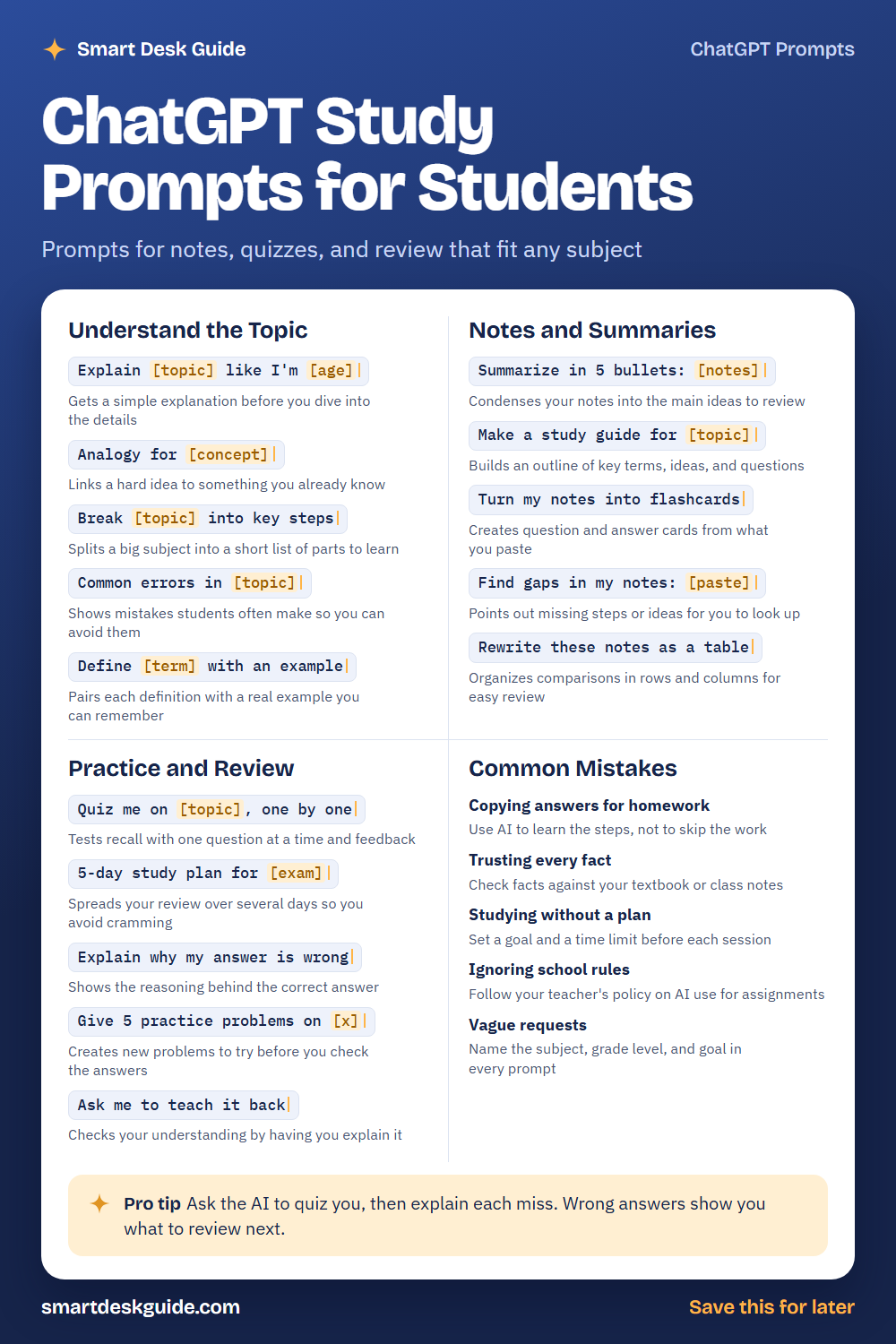
Use the cheat sheet below as a quick reference. Then read on to see when to use each prompt and how it looks filled in.
How to Use These Prompts
Words in [brackets] are blanks. Replace each one with your own details before you send the prompt.
Before: Explain [topic] like I'm [age]
After: Explain photosynthesis like I'm 12.
The more detail you give, the better the answer. Name the subject, your level, and what you want to do with the result. These prompts work the same way in ChatGPT, Claude, and Gemini.
Understand the Topic
Explain [topic] like I’m [age]
Use this when a new idea feels too big. A simple explanation gives you a base to build on. Once it makes sense, ask for the detailed version.
Example: Explain supply and demand like I'm 14.
Analogy for [concept]
An analogy links a hard idea to something you already know. It is a good way to remember how a process works. Ask for two or three analogies and pick the one that clicks.
Example: Give me an analogy for how the immune system fights infection.
Break [topic] into key steps
Big subjects are easier when they become a short list. This prompt splits the topic into parts you can learn one at a time. Check the steps against your textbook.
Example: Break the water cycle into key steps, with one sentence per step.
Common errors in [topic]
Knowing the usual mistakes helps you avoid them. This prompt lists where students often go wrong. Use it before a test to check your own understanding.
Example: List common errors in solving quadratic equations.
Define [term] with an example
A definition alone is easy to forget. Pairing it with an example makes it stick. Ask for one example from everyday life and one from your class.
Example: Define "opportunity cost" with an example a high school student would understand.
Notes and Summaries
Summarize in 5 bullets: [notes]
Long notes hide the main ideas. This prompt boils them down to five points you can review fast. Read the summary next to your notes to make sure nothing important is missing.
Example: Summarize in 5 bullets: The Roman Republic had two consuls, a senate, and public assemblies. Power was shared to prevent one ruler from taking control.
Make a study guide for [topic]
A study guide gives your review a clear shape. Ask for key terms, main ideas, and practice questions in one outline. Edit it so it matches what your teacher covered.
Example: Make a study guide for a unit on the American Revolution with key terms and five review questions.
Turn my notes into flashcards
Flashcards work well for facts and vocabulary. Paste your notes and ask for question-and-answer pairs. Then review them on paper or in a flashcard app.
Example: Turn my notes into flashcards: Mitochondria make energy for the cell. The nucleus stores DNA. Ribosomes build proteins.
Find gaps in my notes: [paste]
Notes often skip steps that seemed obvious in class. This prompt points out missing ideas. Use the list as a guide for what to look up yourself, rather than trusting the AI to fill them in.
Example: Find gaps in my notes: Photosynthesis uses sunlight to make sugar. Plants take in carbon dioxide.
Rewrite these notes as a table
Comparisons are easier to see in rows and columns. This prompt is helpful for topics with several parts, such as types of rocks or government branches. Double-check each cell.
Example: Rewrite these notes as a table comparing igneous, sedimentary, and metamorphic rocks by how they form.
Practice and Review
Quiz me on [topic], one by one
Testing yourself beats rereading. Ask for one question at a time so you can answer before you see feedback. Say what you want the AI to do when you get one wrong.
Example: Quiz me on the causes of World War I, one by one. Wait for my answer before you reply.
5-day study plan for [exam]
Spreading review over several days beats cramming. Tell the AI how much time you have each day and which topics are hardest. Adjust the plan to fit your real schedule.
Example: 5-day study plan for a biology midterm. I have 45 minutes each evening and struggle with genetics.
Explain why my answer is wrong
Seeing the reasoning behind the correct answer helps you fix the pattern, not just the one mistake. Paste your work and ask for the step where it went off track.
Example: Explain why my answer is wrong: I solved 2x + 6 = 14 and got x = 10.
Give 5 practice problems on [x]
New problems keep practice fresh. Try each one before you look at any answers. If you get stuck, ask for a hint instead of the full solution.
Example: Give 5 practice problems on fractions for a sixth grader, with answers at the end.
Ask me to teach it back
Explaining an idea in your own words shows what you truly know. This prompt asks you to teach the topic, then gives feedback on your explanation.
Example: Ask me to teach it back: I just studied how a bill becomes a law. Give feedback on what I missed.
Common Mistakes
Copying answers for homework
Copying skips the learning that homework is meant to build. Use AI to understand the steps instead. Quick fix: ask Walk me through the first step only, then do the rest yourself.
Trusting every fact
AI can state wrong facts in a confident tone. Compare important dates, formulas, and definitions with your textbook or class notes. If they do not match, trust the class material.
Studying without a plan
Random studying wastes time. Before each session, set a goal and a time limit. For example, say I have 30 minutes to review chapter 4 vocabulary.
Ignoring school rules
Schools have different rules for AI. Read your teacher’s policy before you use AI on assignments. When in doubt, ask.
Vague requests
A short, vague prompt gets a generic answer. Name the subject, grade level, and goal every time. A better version of “Help me with math” is Help me practice solving two-step equations at a seventh grade level.
Pro Tip
Ask the AI to quiz you, then explain each miss. Wrong answers show you exactly what to review next, and the explanation fills in the gap while it is fresh.
Example: Quiz me on 10 questions about the solar system. After each wrong answer, explain the right one in two sentences, and list my weak spots at the end.
FAQ
Can ChatGPT help me study?
Yes, as a study partner. It can explain topics, summarize notes, and quiz you. You still have to do the thinking, and you should check facts against your class materials.
Is it cheating to use AI for studying?
It depends on your school’s rules. Using AI to understand a topic or practice is different from having it write your assignment. Read your teacher’s policy and ask if you are unsure.
How do I make AI quizzes harder?
Ask for more advanced questions, or tell the AI to mix topics and skip hints. You can also ask it to write questions in the style of your class tests, based on notes you paste in.
Final Thoughts
AI works best when it helps you learn, not when it does the work for you. Use these prompts to understand, practice, and review, and check the facts with your own class material.
If this guide helped, save the cheat sheet on Pinterest and bookmark this page for your next study session.