Interview nerves are normal. You want to sound clear and confident, but it is hard to know what will be asked or how your answers will land.
This guide gives you ChatGPT prompts for interview preparation that turn worry into practice. You will get prompts to research the role, run a mock interview, handle tricky questions, and avoid the mistakes that make answers sound rehearsed or untrue.
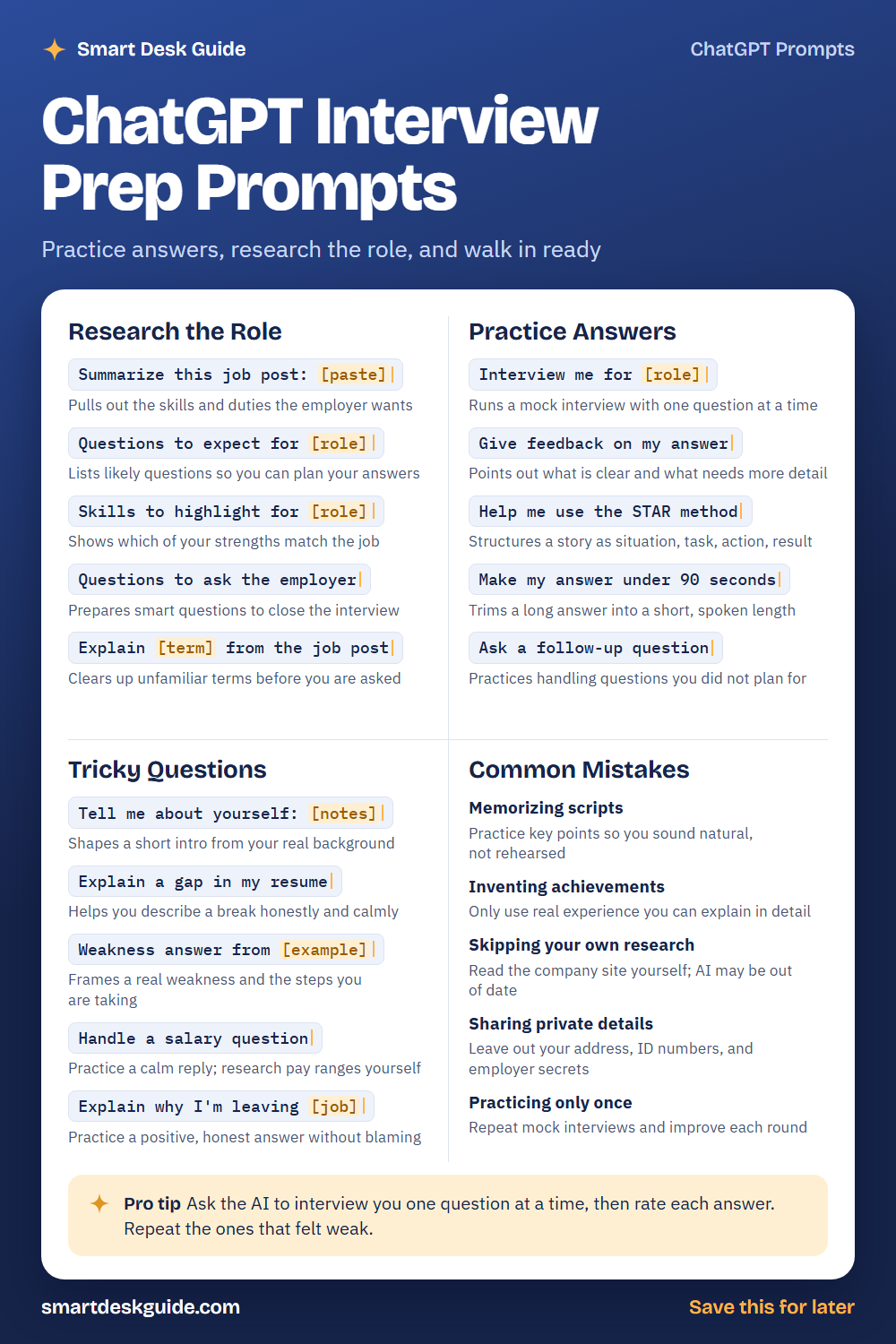
Use the cheat sheet below as a quick reference. Then read on to see when to use each prompt and how it looks filled in.
How to Use These Prompts
Words in [brackets] are blanks. Replace each one with your own details before you send the prompt.
Before: Interview me for [role]
After: Interview me for a customer support specialist role at a small software company.
The more you share about the job and your background, the better the practice. These prompts work the same way in ChatGPT, Claude, and Gemini. Use your real experience in every answer, and never paste private details like your address or ID numbers.
Research the Role
Summarize this job post: [paste]
Job posts can be long and full of buzzwords. This prompt boils one down to the main duties and skills. Use the summary to decide what to study first.
Example: Summarize this job post in plain words: We are hiring a front desk coordinator to greet guests, manage the calendar, and handle phone calls. Experience with scheduling software is a plus.
Questions to expect for [role]
Knowing likely questions lets you plan your answers ahead of time. The AI will suggest common ones for the role. Treat them as practice, since the real interview may differ.
Example: Questions to expect for an entry-level marketing assistant role.
Skills to highlight for [role]
Not every skill matters for every job. This prompt compares the role to your background and picks the strengths to mention. Paste a few lines about your experience so it has something real to work with.
Example: Skills to highlight for an office manager role. My background: five years at a small accounting office, scheduling, filing, and vendor calls.
Questions to ask the employer
Good questions show you care about the job. They also help you decide whether it fits you. Ask for questions about the team, the work, and how success is measured.
Example: Questions to ask the employer at the end of an interview for a project coordinator role.
Explain [term] from the job post
Job posts sometimes use terms you have not seen. Ask the AI to explain one in plain words, then confirm it with a second source. It is better to learn it now than to be surprised in the interview.
Example: Explain "stakeholder management" from the job post, with a simple example.
Practice Answers
Interview me for [role]
A mock interview lets you practice out loud or in writing. Ask for one question at a time so you can answer before the next one comes. Say how many questions you want.
Example: Interview me for a junior graphic designer role. Ask one question at a time and wait for my answer.
Give feedback on my answer
Feedback shows you what works and what does not. Paste your answer and ask for specific comments on clarity and detail. Decide for yourself which changes to keep.
Example: Give feedback on my answer: I organized the schedule for our team and things ran smoothly. Tell me what is unclear.
Help me use the STAR method
The STAR method organizes a story as situation, task, action, and result. It keeps your answers focused. Give the AI your real story, and let it put the pieces in order.
Example: Help me use the STAR method. Story: A customer was upset about a late order, so I called them, fixed the order, and they thanked me.
Make my answer under 90 seconds
Long answers lose the listener. This prompt trims an answer to a spoken length. Read the new version aloud to check the time.
Example: Make my answer under 90 seconds: I started at the bakery as a cashier, then trained new hires, and later helped set the weekly schedule.
Ask a follow-up question
Interviewers often dig deeper than you expect. This prompt practices what happens after your first answer. It helps you stay calm when you get an unplanned question.
Example: Ask a follow-up question about my answer on handling a difficult coworker.
Tricky Questions
Tell me about yourself: [notes]
This is a common opener. Give the AI a few facts about your background and ask for a short intro. Then rewrite it in your own words so it sounds like you.
Example: Tell me about yourself: I have four years in retail, I like solving customer problems, and I want to move into support. Make it a 60-second answer.
Explain a gap in my resume
Gaps happen for many reasons. This prompt helps you describe one calmly and honestly, then move to what you are doing now. Keep it short and true.
Example: Explain a gap in my resume: I took a year off to care for a family member and have since finished an online bookkeeping course.
Weakness answer from [example]
A good answer names a real weakness and shows what you are doing about it. Give the AI an honest example. Avoid answers that pretend a strength is a flaw.
Example: Weakness answer from this example: I sometimes take on too much and forget to ask for help. I now use a weekly task list.
Handle a salary question
Salary questions can feel uncomfortable. This prompt lets you practice a calm reply. Look up typical pay ranges yourself from trusted sources rather than relying on AI numbers.
Example: Handle a salary question for an office role. I have researched typical pay and want to give a range.
Explain why I’m leaving [job]
Employers often ask why you are leaving. A positive, honest answer works best, without blaming others. Focus on what you are moving toward.
Example: Explain why I'm leaving my job at a retail store. I want more chances to work with customers one-on-one.
Common Mistakes
Memorizing scripts
Reciting an answer word for word can sound stiff. Practice the key points instead. Quick fix: write three bullet points per answer and speak from those.
Inventing achievements
Never let the AI add results you cannot explain. An interviewer may ask for details. Only use experience that is true, and be ready to talk about it.
Skipping your own research
AI may be out of date or wrong about a company. Read the company’s website yourself, and check recent news from reliable sources.
Sharing private details
Leave out your home address, ID numbers, and any confidential information from your current employer. Use general terms like my current company instead.
Practicing only once
One practice round rarely fixes weak spots. Repeat the mock interview and try to improve each time. Focus on the answers that felt hardest.
Pro Tip
Ask the AI to interview you one question at a time, then rate each answer. Repeat the ones that felt weak until they feel natural.
Example: Interview me for a receptionist role, one question at a time. After each answer, rate it from 1 to 5 and tell me one thing to improve.
FAQ
Can ChatGPT help me prepare for an interview?
Yes. It can suggest likely questions, run a mock interview, and give feedback on your answers. You still need to use your own real experience and check any facts about the company.
Should I memorize AI-written answers?
It is better not to. Answers you did not write in your own words tend to sound stiff. Use the AI to organize your ideas, then practice speaking them naturally.
How many times should I practice?
There is no perfect number. Practice until your main stories feel comfortable, and repeat the questions that were hardest. A few short rounds usually help more than one long one.
Final Thoughts
AI is a patient practice partner that never gets tired of mock interviews. Use it to organize your real stories, then say them in your own voice. Check facts yourself, and keep private information out of the chat.
If this guide helped, save the cheat sheet on Pinterest and bookmark this page before your next interview.